
Your website is often the first place potential customers interact with your business. Before contacting your team, requesting a quote, visiting your location, or making a purchase, many people will check your website to understand what you offer and whether your business looks trustworthy. That means an outdated, slow, confusing, or poorly structured website can affect more than your online appearance. It can directly influence traffic, engagement, leads, sales, and customer perception.
Many businesses continue using the same website for years because it technically works. However, simply having a website that loads does not mean it is still performing well. Design trends change, search engines evolve, customer expectations increase, mobile usage grows, and businesses themselves change over time. A website that worked effectively three or four years ago may no longer support your current marketing and business goals.
Knowing the time to redesign your website is therefore less about following a specific number of years and more about looking at how your website performs today. If visitors are leaving quickly, your pages are difficult to navigate, your website looks outdated, or your competitors are providing a much better online experience, a redesign may be worth considering.
What Does a Website Redesign Actually Mean?
A website redesign is more than changing colors, fonts, images, or a homepage layout. A professional redesign evaluates the website as a complete digital platform and improves its structure, user experience, content, performance, design, technical setup, and conversion journey.
Depending on the condition of the existing website, a redesign may involve updating the visual design, rebuilding pages, improving navigation, restructuring content, optimizing mobile responsiveness, improving loading speed, fixing technical problems, and strengthening SEO.
The goal is not to make a website look different simply for the sake of change. The website redesign goals should be connected to a measurable business requirement. For one company, that might mean generating more leads. For another, it could be improving ecommerce sales, supporting a new brand identity, attracting organic traffic, or making it easier for customers to find important information.
12 Signs It’s Time to Redesign Your Website
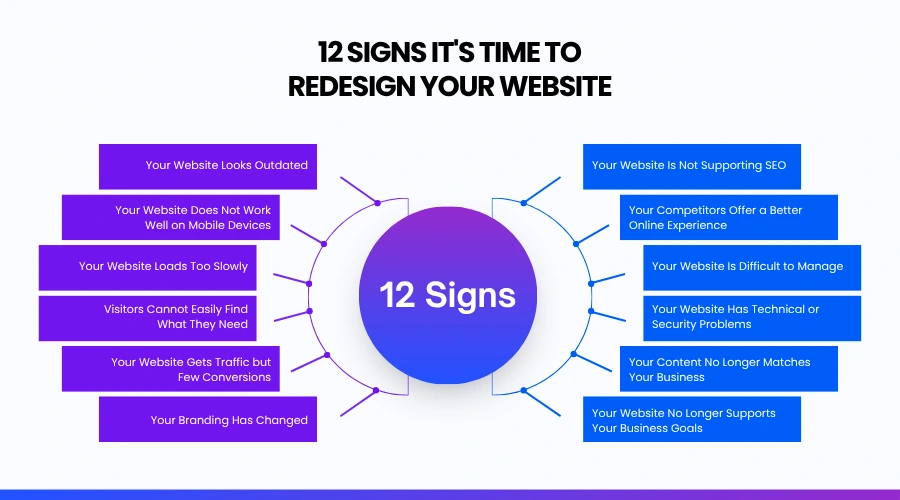
There is no universal rule saying that every website must be redesigned after a certain number of years. Some websites remain effective for a long time because they are regularly maintained and updated. Others become outdated much faster because the business, technology, or customer expectations have changed.
Here are some of the most common signs that indicate it may be time to redesign your website.
1. Your Website Looks Outdated
First impressions matter online. If your website still uses an old visual style, crowded layouts, outdated graphics, inconsistent fonts, or design patterns that make it look several years behind your competitors, visitors may question whether your business is equally outdated.
Modern website design focuses on clarity, spacing, readability, intuitive navigation, responsive layouts, and strong visual hierarchy. A redesign can help present your business in a way that matches its current level of professionalism.
This does not mean your website needs to follow every design trend. Good redesign decisions should support your brand rather than making the website look fashionable for only a few months.
2. Your Website Does Not Work Well on Mobile Devices
Mobile responsiveness is no longer an optional feature. People regularly access business websites through smartphones and tablets, and a website that looks good only on desktop computers can create a poor user experience.
Common mobile problems include text that is too small, buttons that are difficult to tap, images that overflow the screen, menus that are confusing, and sections that require excessive scrolling.
If your website is difficult to use on a smartphone, this can affect both user satisfaction and conversions. A redesign provides an opportunity to rethink layouts for smaller screens instead of simply shrinking the desktop version.
3. Your Website Loads Too Slowly
Website visitors are unlikely to wait patiently for a page that takes too long to load. Large images, unnecessary scripts, outdated plugins, poor hosting configurations, excessive animations, and inefficient code can all contribute to slow performance.
A redesign can address these problems by reviewing the technical foundation of the website and improving how assets, images, scripts, and content are delivered.
Speed should not be treated as a cosmetic improvement. A faster website can create a smoother experience and make it easier for visitors to reach important pages.
4. Visitors Cannot Easily Find What They Need
A website can contain excellent information and still perform poorly if visitors cannot find it.
Confusing navigation, too many menu items, unclear page names, missing internal links, and poorly organized content can make users work too hard to find basic information. When people cannot quickly understand where to go next, they may simply leave.
A redesign gives businesses the opportunity to reorganize the sitemap and create a more logical journey from the homepage to important service, product, contact, or conversion pages.
5. Your Website Gets Traffic but Few Conversions
Traffic alone does not guarantee business growth. If your website receives visitors but very few people contact you, request a quote, book a service, submit a form, or purchase a product, there may be problems with the conversion experience.
Your calls to action might be difficult to find. Your service pages may not explain the value clearly. Your forms may be too complicated. Or visitors may simply lack confidence in the business.
These are important reasons for website redesign because the website should not only attract visitors but also help them take the next logical step.
6. Your Branding Has Changed
Businesses evolve. You may have changed your logo, colors, services, target audience, messaging, or overall brand positioning since your website was created.
When the website no longer represents the current business, the disconnect becomes noticeable. Visitors might see one version of your brand on social media and another version on your website.
A redesign can bring your visual identity and messaging together so that customers receive a consistent experience across your digital channels.
7. Your Website Is Not Supporting SEO
SEO requires more than adding keywords to pages. Website structure, technical performance, mobile usability, internal linking, page experience, content organization, metadata, redirects, and indexability can all affect organic visibility.
If your existing website has a weak structure or makes it difficult to create and manage optimized pages, rebuilding the site may provide a stronger foundation for long-term SEO.
However, redesigning a website without considering SEO migration can also create problems. Existing URLs, rankings, backlinks, metadata, and indexed pages need to be reviewed before launch.
8. Your Competitors Offer a Better Online Experience
Your website should be evaluated in the context of your market, not in isolation.
If competitors have faster websites, clearer service pages, stronger calls to action, better mobile experiences, easier navigation, and more useful content, potential customers may naturally perceive them as more professional.
You do not need to copy your competitors. Instead, analyze what their websites make easier for users and identify where your own website creates unnecessary friction.
9. Your Website Is Difficult to Manage
If adding a new service page requires technical assistance every time, updating content takes too long, or your CMS is outdated, maintaining the website can become unnecessarily expensive.
A modern website should allow your team to manage routine content updates efficiently. Depending on your requirements, a redesign may involve improving the CMS, simplifying the backend, replacing outdated plugins, or restructuring templates.
10. Your Website Has Technical or Security Problems
Old websites can accumulate technical issues over time. Outdated plugins, unsupported software, broken functionality, insecure configurations, and compatibility problems can make a website unreliable.
Not every technical problem requires a complete redesign. Sometimes maintenance is enough. But if technical issues are connected to an outdated architecture or a heavily modified system, rebuilding may be more practical.
11. Your Content No Longer Matches Your Business
Your website may still talk about services you no longer provide while failing to mention services you now specialize in. Old statistics, outdated company information, discontinued products, weak service descriptions, and irrelevant pages can reduce trust.
Content should support the current customer journey. During a redesign, businesses can review existing pages, remove unnecessary content, improve important pages, and create a clearer structure.
12. Your Website No Longer Supports Your Business Goals
Perhaps the biggest warning sign is that the website simply does not help you achieve what you need it to achieve.
If your business has expanded into new markets, introduced new services, started selling online, shifted toward lead generation, or changed its target audience, the website should reflect those changes.
This is one of the strongest indicators of the time to redesign your website because the site should support where your business is going, not just represent where it was several years ago.
What Are the Main Reasons for Website Redesign?
The reasons for website redesign are different for every business, but they usually fall into several major categories: user experience, performance, branding, SEO, conversions, technology, and business growth.
Some redesigns begin because a website looks outdated. Others start because the business is losing leads or struggling with organic visibility. In many cases, several problems exist at the same time. A website redesign may be appropriate when the existing site has become difficult to maintain, when its structure no longer matches the business, or when customer expectations have changed significantly.
The most important point is that a redesign should solve a real problem. Changing the website only because competitors have launched new designs can waste time and money. A better approach is to audit the current website first and identify what is actually preventing it from performing well.
What Are the Benefits of Website Redesign?
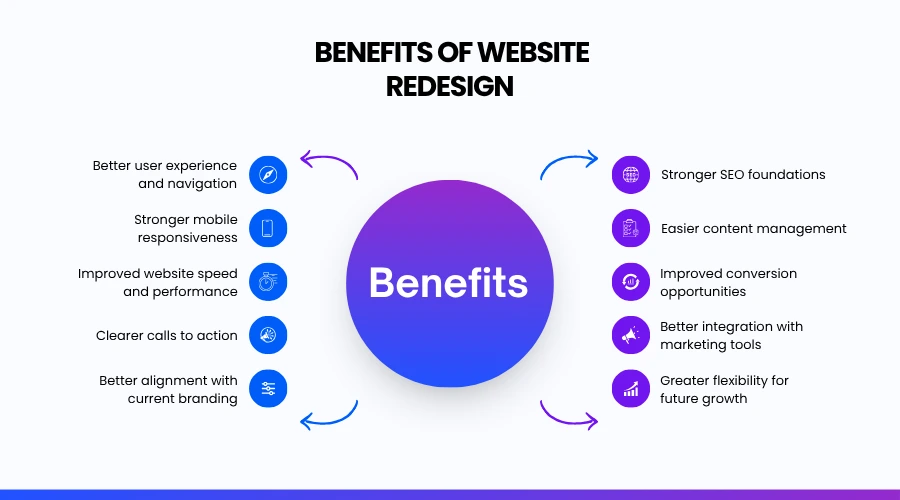
The benefits of website redesign go beyond creating a more attractive homepage. When a redesign is planned around business objectives, it can improve multiple areas of the customer journey.
A better structure can make information easier to find. A responsive layout can improve the mobile experience. Stronger calls to action can support lead generation. Better technical performance can create a smoother browsing experience. Updated content can communicate the company’s current services more effectively.
Some common benefits include:
- Better user experience and navigation
- Stronger mobile responsiveness
- Improved website speed and performance
- Clearer calls to action
- Better alignment with current branding
- Stronger SEO foundations
- Easier content management
- Improved conversion opportunities
- Better integration with marketing tools
- Greater flexibility for future growth
The most valuable benefits of website redesign come when these improvements work together rather than being treated as separate changes.
How to Define Your Website Redesign Goals
Before discussing colors, layouts, or animations, determine what the redesign needs to accomplish. Your website redesign goal should be specific enough that you can evaluate whether the new website actually improved performance.
For example, “make the website better” is not a useful goal. A stronger objective could be increasing qualified leads, improving ecommerce conversions, reducing bounce rates, improving mobile usability, increasing organic traffic, or making the website easier for internal teams to manage.
A redesign can have more than one goal, but there should still be a clear priority.
Consider these questions before beginning:
- What is currently not working?
- What do visitors struggle with?
- Which pages generate the most business value?
- Where are users leaving the website?
- What actions do you want visitors to take?
- What has changed in the business since the website was created?
- Which SEO rankings or URLs need to be protected?
- What should the new website make easier?
A clearly defined website redesign goals help designers, developers, SEO specialists, and content writers work toward the same outcome.
How Long Does a Website Redesign Take?
One of the most common questions businesses ask is how long their project will require. If you have searched for “how long does a website redesign take,” there is no single answer because project timelines depend on the website’s size, functionality, content requirements, design complexity, and development platform.
A small business website with a limited number of pages may take several weeks. A large corporate website, ecommerce store, booking platform, or custom web application can require several months.
A typical project may include the following stages:
| Website Redesign Stage | Possible Time |
| Website audit and planning | 1–2 weeks |
| Sitemap and content planning | 1–2 weeks |
| UI/UX design | 1–3 weeks |
| Development | 2–6+ weeks |
| Content migration | 1–3 weeks |
| SEO setup and redirects | 1–2 weeks |
| Testing and revisions | 1–2 weeks |
| Launch | Usually 1–2 days |
These are general estimates rather than fixed deadlines. If content is not ready, feedback is delayed, or the website contains complex functionality, the timeline can increase.
When businesses ask “how long does a website redesign take,” the better question is what level of redesign the website actually needs. A visual refresh can be relatively quick, while a complete rebuild involving SEO migration, ecommerce functionality, custom integrations, and extensive content restructuring will require considerably more planning.
What Is the Average Cost for Website Redesign?
The average cost for website redesign varies significantly depending on the scope of the project. There is no single price that applies to every business because a five-page service website and a large ecommerce platform have completely different requirements.
The cost can be influenced by:
- Number of pages
- Custom UI/UX design requirements
- CMS or development platform
- Ecommerce functionality
- Custom features and integrations
- Content writing and migration
- SEO requirements
- Existing technical problems
- Third-party integrations
- Animation and interactive elements
- Testing and post-launch support
When researching the average cost for website redesign, businesses should avoid choosing a provider based only on the lowest quote. A low initial price may not include content migration, SEO protection, responsive development, testing, or post-launch fixes.
A more useful approach is to compare the project scope. Ask what is included in the redesign, what happens to existing SEO URLs, whether content is included, how revisions work, and what support is available after launch.
For this reason, the average cost for website redesign should always be evaluated alongside the expected scope and business value rather than considered as a standalone number.
The Website Redesign Process
A successful redesign usually begins long before the first new design is created. At Innovatek Solutions, the process can be approached as a structured project where business objectives, user experience, design, development, and SEO work together.
1. Website Audit
The first step is understanding the existing website. This includes reviewing its design, content, performance, technical setup, SEO, navigation, mobile experience, and conversion paths.
The audit helps identify what should be retained, improved, removed, or rebuilt.
2. Strategy and Goal Setting
Next, the redesign requirements are defined. This is where the primary website redesign goal is established along with secondary objectives.
A clear strategy prevents the project from becoming focused only on visual changes.
3. Sitemap and Content Planning
The website structure is reviewed before development begins. Pages may be reorganized, consolidated, removed, or created based on user needs and business priorities.
Existing SEO URLs should also be reviewed carefully at this stage.
4. UI/UX Design
Designers create the visual direction and user experience for the new website. This includes layouts, typography, colors, buttons, forms, navigation, responsive behavior, and page hierarchy.
The objective is to make the website visually professional while also making it easy to use.
5. Development
Once designs are approved, the website is developed. The exact process depends on the platform and requirements.
Development should account for responsive behavior, page speed, accessibility, functionality, integrations, and technical SEO.
6. Content and SEO Migration
Existing content is reviewed and migrated where appropriate. Important URLs should be preserved or redirected properly when URLs change.
Metadata, headings, internal links, structured data, canonical tags, images, and other SEO elements should also be checked.
7. Testing
Before launch, the website should be tested across different screen sizes and major browsers. Forms, buttons, menus, links, images, checkout processes, and other functionality should be checked.
SEO and performance checks should also be completed before the new website replaces the old one.
8. Launch and Monitoring
Launching the website is not the end of the project. Performance, rankings, indexing, conversions, errors, and user behavior should be monitored after launch.
A proper post-launch review can identify issues that were not visible during development.
Common Website Redesign Mistakes to Avoid
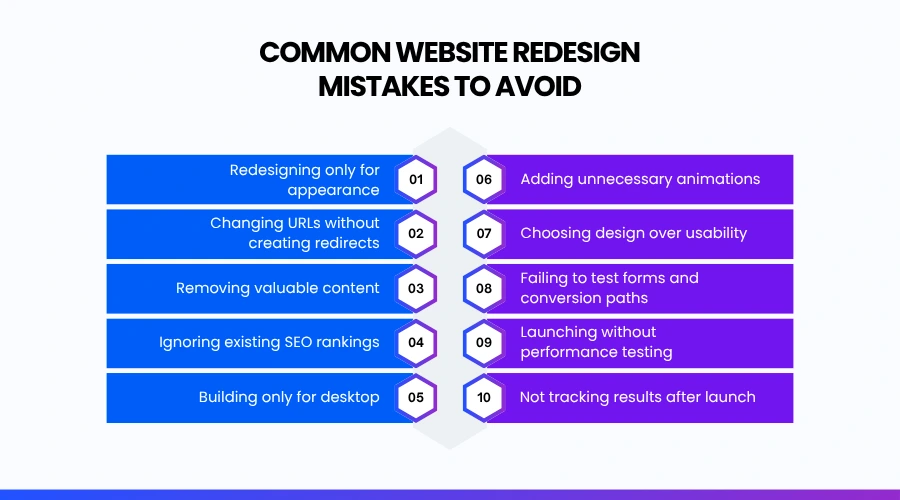
A redesign can create new problems if it is handled without proper planning. Some of the most common mistakes include:
- Redesigning only for appearance
- Changing URLs without creating redirects
- Removing valuable content
- Ignoring existing SEO rankings
- Building only for desktop
- Adding unnecessary animations
- Choosing design over usability
- Failing to test forms and conversion paths
- Launching without performance testing
- Not tracking results after launch
One particularly serious mistake is treating the new website as completely separate from the old one. Your existing website may already have rankings, backlinks, indexed pages, traffic, and customer data. These assets should be protected wherever possible.
Website Refresh vs. Complete Redesign: Which Do You Need?
Not every website requires a complete rebuild. If the current website has a strong technical foundation but outdated colors, images, typography, or certain layouts, a visual refresh may be enough. Similarly, if only a few pages have problems, targeted improvements may solve the issue.
A full redesign becomes more appropriate when the website has deeper structural problems, outdated technology, poor mobile performance, weak navigation, major SEO issues, or a mismatch between the website and the current business.
The decision should come from an audit rather than assumptions.
Why Choose Innovatek Solutions for Website Redesign?
Innovatek Solutions approaches website redesign as more than a visual project. A successful business website needs design, development, content, SEO, performance, and conversion strategy to work together.
Whether a business needs a modern corporate website, service-based website, ecommerce platform, or a complete website rebuild, the process should begin with understanding the existing problems and defining what the new website needs to accomplish.
The team can evaluate the current website, identify areas for improvement, plan the new structure, develop the redesigned experience, and consider SEO requirements throughout the process.
If your current website no longer represents your business or produces the results you expect, this may be the time to redesign your website.
Visit Innovatek Solutions to learn more about Innovatek Solutions’ website development and digital marketing services.
Frequently Asked Questions
How do I know when it is time to redesign my website?
Look for several problems happening at the same time, such as an outdated design, poor mobile experience, slow loading, weak conversions, difficult navigation, outdated content, or technical limitations. These are strong indicators that it may be the time to redesign your website.
What are the biggest reasons for website redesign?
Common reasons for website redesign include outdated design, poor mobile performance, weak user experience, low conversions, technical limitations, SEO problems, changing business goals, and outdated branding.
What are the main benefits of website redesign?
The benefits of website redesign can include better user experience, stronger mobile performance, improved navigation, better SEO foundations, clearer calls to action, easier content management, and more opportunities for conversions.
What should be the main website redesign goal?
Your website redesign goal should be connected to a measurable business outcome. This could include generating more qualified leads, increasing sales, improving organic traffic, supporting a new market, or making the website easier for customers to use.
How long does a website redesign take?
If you are asking “how long does a website redesign take,” the answer depends on the project’s size and complexity. A small business website may take several weeks, while a large ecommerce or custom website can take several months.
What affects the average cost for website redesign?
The average cost for website redesign depends on the number of pages, design requirements, platform, functionality, content, SEO work, integrations, ecommerce features, and development complexity.
Should I redesign my website or build a new one?
If the current platform is technically sound and only the design or content needs improvement, a redesign may be enough. If the architecture, technology, functionality, and structure are outdated, rebuilding the website may be the better option.
Conclusion
A website should grow with your business. As your services, customers, branding, marketing strategy, and technology change, your website needs to keep up. An outdated website can create friction for visitors, limit marketing performance, weaken conversions, and make your business look less professional than it actually is.
The decision to redesign should not be based simply on how old your website is. Instead, evaluate its performance, user experience, technical condition, SEO, content, and ability to support your current objectives.
If your website looks outdated, performs poorly on mobile, loads slowly, generates few leads, has confusing navigation, or no longer reflects your business, the signs may be clear. Understanding the reasons for website redesign, defining the right website redesign goal, and planning the project properly can help you build a website that is useful not only today but also as your business grows.
For businesses that are considering a redesign, Innovatek Solutions can help evaluate the existing website and develop a stronger digital experience based on business and marketing requirements. If your current website also needs a platform change to support your ecommerce goals, read our blog “How to Migrate to Shopify Plus” to understand the migration process, key benefits, and important SEO considerations.